

10 Reasons Your Weight May Be Stuck
A Functional Medicine Dietitian Explains Why Healthy Eating May Not Be Enough, and What to Look at Next
| Key Takeaways Eating healthy and eating in a way that fits your current body are not the same thing. Women lose muscle mass at roughly 3 to 8 percent per decade after age 30, and declining estrogen shifts fat storage toward the abdomen. Low protein, low fiber, disrupted sleep, and reduced daily movement outside the gym are the most commonly overlooked contributors. Medications, medical history, and metabolic health deserve assessment before assuming the problem is willpower. Weight that will not move is usually a strategy problem, not an effort problem. |
You choose healthy foods.
You watch your portions. You rarely eat fast food. You exercise. You may have reduced sugar, carbohydrates, alcohol, or processed foods. Perhaps you have tried intermittent fasting, tracking your food, increasing your steps, or following another carefully structured eating plan.
And still, the scale barely moves.
Or perhaps you lose a few pounds, only to find yourself right back where you started. One of the most common things I hear from women is:
“I eat so healthy. Why am I not losing weight?”
It is a reasonable question.
But after more than 25 years working in nutrition, I have learned that the better question is often: “What might be keeping my body from responding the way I expect?”
Because healthy eating matters enormously, but weight regulation is more complex than simply dividing foods into “healthy” and “unhealthy.”
Your energy needs, muscle mass, age, menopausal status, sleep, physical activity, medications, health conditions, eating patterns, appetite, environment, stress, and behavioral patterns can all be part of the picture.
That is why my approach begins with investigation, not judgment.
As a Functional Medicine Dietitian in Greenville, South Carolina, with more than 25 years of experience, I work with women who are eating well and doing many of the “right” things, yet still struggle with weight, body composition, or metabolic health. My approach is to look beyond the food alone and understand the individual factors that may be influencing their progress.
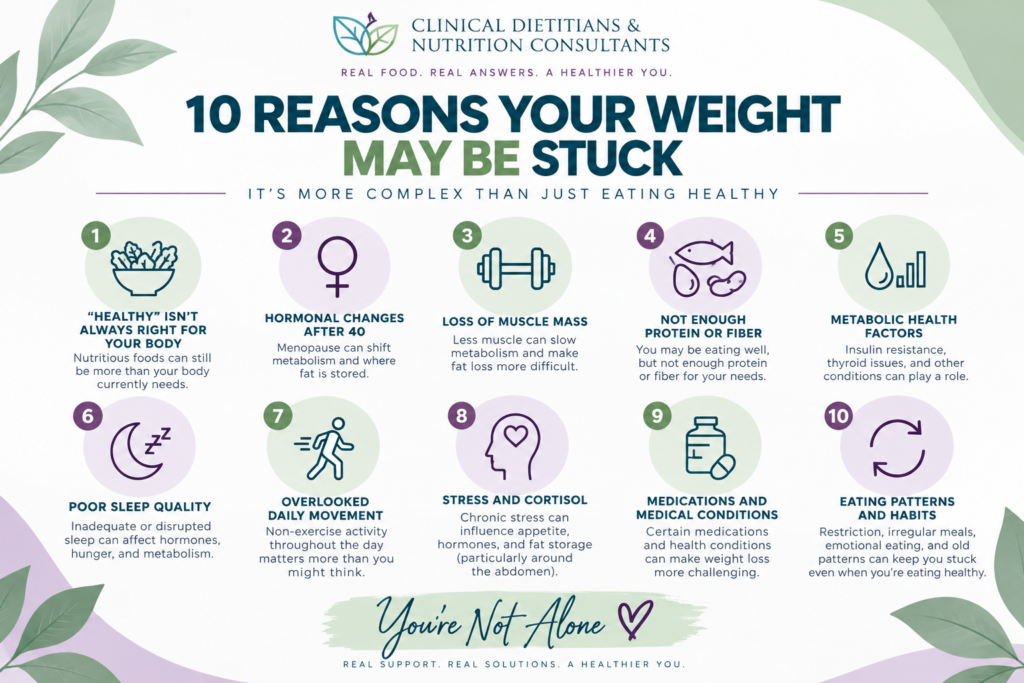
1. Why Eating Healthy Does Not Always Equal Fat Loss
A diet can be genuinely nutritious and still not match what your body currently needs. Olive oil, nuts, nut butters, avocado, granola, smoothies, protein bars, and restaurant salads are all nutritious choices, and the overall dietary pattern still matters when fat loss is the goal. Restricting further is not automatically the answer either, because aggressive restriction brings its own problems with hunger, fatigue, and inadequate protein.
A woman can eat an exceptionally nutritious diet and still consume more energy than her body currently requires.
The reverse can also happen.
Some women restrict so aggressively that they struggle with hunger, fatigue, inadequate protein or nutrient intake, decreased spontaneous activity, and a pattern of restriction followed by overeating.
Neither situation means she has failed.
It means we need to look more closely.
Olive oil, nuts, nut butters, avocado, granola, smoothies, protein bars, and restaurant salads can all be nutritious choices, but portions and the complete dietary pattern still matter when fat loss is a goal.
At the same time, simply cutting calories lower and lower is not necessarily the answer.
Healthy eating and a nutrition strategy designed for your individual goals are not always the same thing.
2. Aging and the Menopausal Transition Change What Your Body Needs
The body you have at 45 is not metabolically identical to the body you had at 30. Women lose muscle mass at a rate of roughly 3 to 8 percent per decade after age 30, and declining estrogen during menopause shifts where fat is stored, particularly toward the abdomen. Menopause does not make weight loss impossible. It means the strategy that worked at 30 may need to change.
Women often tell me:
“This is exactly how I used to eat, and I never had a problem with my weight.”
I believe them.
But the body you have today is not metabolically identical to the body you had at 30 or 35.
With aging, changes can occur in muscle mass, activity, energy expenditure, and body composition. During the menopausal transition, hormonal changes may also influence where fat is stored, particularly around the abdomen.
That does not mean menopause makes weight loss impossible.
It means your strategy may need to evolve with your physiology.
Instead of trying harder to make an old strategy work, I often ask:
What does this body need now?
3. Muscle Loss: The Metabolic Asset Most Weight-Loss Plans Overlook
Muscle supports strength, mobility, glucose metabolism, and healthy aging, and it is often lost alongside fat when a weight-loss plan is built on eating less and doing more cardio. Protecting muscle requires adequate protein, resistance exercise, and recovery. This is also why the scale alone is a poor measure of progress: body composition, waist circumference, and strength tell you considerably more.
When women think about weight loss, they usually think about losing fat. I also think about protecting muscle.
Muscle is essential for far more than appearance. Maintaining muscle supports strength, mobility, physical function, glucose metabolism, healthy aging, and overall metabolic health.
This becomes increasingly important with age.
If a weight-loss strategy consists primarily of eating less and doing more cardio, without adequate protein, resistance exercise, and recovery, a woman may not be adequately supporting lean body mass.
That is why I don’t evaluate progress using the scale alone.
Depending on the individual, I may also consider:
- Waist circumference
- Body composition
- Strength
- Dietary protein
- Resistance exercise
- Daily movement
- Energy and recovery
The goal is not simply to become lighter.
The goal is to improve body composition while building a body that remains metabolically healthy, strong, and capable.
4. Low Protein and Low Fiber: The Two Most Common Gaps in a “Healthy” Diet
A food record can look beautifully healthy and still be low in protein, fiber, or both. Oatmeal and fruit for breakfast, a salad for lunch, and vegetables with a small amount of protein at dinner is a nutritious pattern that may still not meet the needs of a woman who is active, dieting, or trying to preserve muscle as she ages. The useful question is not whether you are eating clean, but whether the pattern meets your body’s needs.
Sometimes I review a food record that looks beautifully healthy but is surprisingly low in protein.
Breakfast might be oatmeal and fruit.
Lunch might be a salad.
Dinner might include vegetables and a small amount of protein.
Nothing is inherently wrong with those foods.
But the overall pattern may not provide enough protein for that woman’s needs, particularly if she is active, dieting, or trying to preserve muscle as she ages.
Fiber matters too.
Vegetables, berries, legumes, seeds, appropriate whole grains, and other fiber-rich plant foods can support satiety, digestive health, cardiometabolic health, and overall diet quality.
Rather than asking only: “Am I eating clean?”
I want to know: “Is this eating pattern actually meeting my body’s needs?”
Those are very different questions.
5. Metabolic Health: Insulin Resistance, Thyroid, and What Deserves Testing
Difficulty losing weight does not automatically mean you have insulin resistance, a thyroid disorder, or a damaged metabolism. Those explanations are oversimplified online. But when weight changes unexpectedly, or when there are other symptoms, risk factors, or relevant medical history, it can be appropriate to look at glucose regulation, lipids, blood pressure, thyroid status, medications, sleep, and body composition alongside the scale.
Difficulty losing weight does not automatically mean you have insulin resistance, a thyroid disorder, or a “damaged metabolism.”
Those explanations are often oversimplified online.
But when weight is unexpectedly changing, or when a woman has other symptoms, risk factors, or a relevant medical history, it can be appropriate to look beyond the scale.
Depending on the individual and in collaboration with her healthcare team, the bigger picture may include factors such as:
- Glucose regulation
- Blood pressure
- Lipid and cardiovascular risk
- Thyroid status when clinically indicated
- Medications
- Menopausal status
- Sleep
- Body composition
- Family and medical history
- Digestive health
- Relevant laboratory findings
I am not interested in ordering every possible test simply because a woman cannot lose five pounds.
I am interested in asking the right questions so that important information is not overlooked.
| Not sure which of these applies to you? That is exactly what a comprehensive assessment is for. Schedule a consultation in Greenville, SC. |
6. Poor Sleep Makes Weight Management Harder
You can have an excellent nutrition plan and still struggle if you are chronically exhausted. Insufficient or fragmented sleep affects appetite, food choices, glucose metabolism, recovery, energy, and how consistently you move, and sleep deficiency is linked to obesity. In midlife, sleep is often disrupted by hot flashes, night sweats, insomnia, and stress, and persistent problems such as obstructive sleep apnea deserve medical evaluation rather than being blamed on menopause.
You can have a beautiful nutrition plan and still struggle if you are chronically exhausted.
Poor or insufficient sleep can influence appetite, food choices, glucose metabolism, recovery, energy, and physical activity.
For women in midlife, this can become particularly relevant when sleep is disrupted by hot flashes, night sweats, insomnia, stress, or frequent waking.
And persistent sleep problems should not automatically be blamed on menopause. Conditions such as obstructive sleep apnea may warrant medical evaluation.
Sometimes a woman tells herself:
“I just need more discipline.”
But when we look deeper, she is sleeping five or six fragmented hours, waking exhausted, reaching for quick energy during the afternoon, and struggling to exercise consistently.
That is not simply a food problem.
Sleep belongs in the metabolic conversation. If persistent tiredness is your main concern, I have written separately about why women lose energy in midlife.
7. Your Daily Movement Outside the Gym May Have Decreased
A structured workout is only one part of daily energy expenditure. Walking, standing, household activities, errands, and stairs all contribute, and that background movement can drop substantially with a desk job, remote work, injury, fatigue, or caregiving. A woman can exercise four times a week and still spend most of her waking hours sitting. The more useful question is how much movement is built into the day.
Going to the gym is valuable.
But your workout is only one part of your daily movement.
Walking, standing, household activities, errands, taking stairs, and simply moving throughout the day all contribute to energy expenditure.
A woman may exercise four times per week and still spend most of her remaining waking hours sitting.
This becomes particularly relevant with desk jobs, remote work, injury, fatigue, caregiving responsibilities, and lifestyle changes.
Instead of focusing exclusively on: “How many calories did I burn at the gym?”
I also want to know: “How much movement is built into your life?”
Sometimes improving metabolic health is less about adding another punishing workout and more about creating a life in which your body moves regularly throughout the day.
8. Medications and Medical History Can Affect Body Weight
Some medications influence body weight or appetite, and some medical conditions contribute to unexplained weight change. That is not a reason to stop a medication on your own. It is a reason for your medication list and medical history to be part of a thorough nutrition assessment and, when appropriate, discussed with the prescribing clinician.
Sometimes the missing piece is not on the plate at all.
Certain medications can influence body weight or appetite, and medical conditions can sometimes contribute to unexplained weight changes.
That does not mean you should stop a medication because you think it is affecting your weight.
It means your medication list belongs in a thoughtful assessment and, when appropriate, should be discussed with the prescribing clinician.
The same is true of medical history.
A sophisticated weight-management plan should consider the whole person, not simply what she ate for breakfast.
9. Chronic Stress Changes Behavior More Than It Changes Cortisol
Blaming abdominal fat on high cortisol oversimplifies the physiology, but stress still deserves attention. Chronic stress affects sleep, appetite, alcohol intake, food choices, movement, and recovery, and the effect is often behavioral rather than hormonal. A woman may eat well all day and graze all evening, not from a lack of knowledge, but because food has become the transition from responsibility to relief.
I am cautious when I hear every pound of abdominal fat blamed on “high cortisol.” Human physiology is more complicated than that.
But stress absolutely deserves attention.
Chronic stress can affect sleep, appetite, alcohol intake, food choices, movement, recovery, and the ability to consistently practice health-supportive behaviors.
And sometimes the effect is subtle.
A woman may eat beautifully all day and then spend every evening grazing in the kitchen, not because she lacks nutrition knowledge, but because food has become her transition from responsibility to relief.
That is where nutrition counseling alone may not be enough.
We need to understand the pattern beneath the eating.
10. The Behavior Pattern Beneath the Eating
When eating has become automatic, another meal plan rarely changes it. The sequence usually runs trigger, thought, emotion, automatic behavior, temporary relief, and it repeats because it works in the short term. Interrupting it means identifying the trigger, examining the thought, recognizing what is actually needed, and rehearsing a different response, rather than adding another list of foods to avoid.
This is where my approach goes beyond simply telling a woman what to eat. Nutrition matters.
But so do thoughts, habits, triggers, emotions, environment, and the language we repeatedly use with ourselves.
Consider this pattern:
| Trigger → Thought → Emotion → Automatic Behavior → Temporary Relief |
A difficult workday ends.
You walk into the kitchen.
You think: “I deserve something.”
You begin eating while standing at the counter.
For a few minutes, you feel relief.
The next thought is: “I ruined today anyway.”
And the eating continues.
Giving that woman another list of foods to avoid may not solve the problem.
Instead, I may help her identify the trigger, examine the thought, recognize what she actually needs, and mentally rehearse a different response.
Perhaps:
| Work ends → Pause → Three slow breaths → Change clothes → Step outside → Ask, “Am I physically hungry, or am I looking for relief?” |
If she is hungry, she eats.
If she needs decompression, she begins developing another way to meet that need.
This is where I integrate evidence-informed behavior-change principles with transformational and NLP-informed strategies.
Not to “think away” physiology.
But to create conscious choice where behavior has become automatic.
Food Is More Than Nutrients, and That Matters
There is another reason traditional dieting often fails women.
It reduces food to numbers. Calories. Carbohydrates. Protein. Points. Good foods. Bad foods.
But food is also pleasure, family, memory, tradition, culture, celebration, and connection.
Through my Food & Spirit approach, I want women to develop greater awareness around eating, not greater fear of food.
- Can you sit down and actually experience your meal?
- Can you recognize hunger?
- Can you recognize satisfaction?
- Can you enjoy something pleasurable without immediately thinking: “I was bad. I ruined everything. I’ll start again Monday”?
One choice does not erase your progress.
A sustainable nutrition strategy needs to support both metabolic health and a healthy relationship with food.
What I Look At When Weight Will Not Move
A thorough assessment starts with history rather than a meal plan. It looks at what changed and when, what and how a woman eats, her protein and fiber intake, her muscle mass and strength, how much she moves outside the gym, how she sleeps, her medications, where she is in the menopausal transition, what her health history shows, what patterns appear around stress and evenings, what she has already tried, and what she can realistically sustain.
When a woman comes to me because her weight will not move, I want to understand much more than what she is eating.
I want to understand:
- What changed? When did it change?
- What does she eat, and how does she eat?
- How much protein and fiber is she getting?
- How is her muscle mass and strength?
- How much does she move outside the gym?
- How does she sleep?
- What medications does she take?
- Where is she in the menopausal transition?
- What does her health history tell us?
- What patterns occur around stress, fatigue, evenings, weekends, or travel?
- What has she already tried?
- And perhaps most importantly: what can she realistically sustain?
This is the difference between handing someone another diet and developing a strategy for an actual human being.
How a Functional Medicine Dietitian Approaches Weight Loss Resistance
A functional approach to weight that will not move looks for connections rather than a single cause. Nutrition, metabolism, muscle, sleep, stress, digestion, health history, behavior, thought patterns, and lifestyle are assessed together, because treating one number while ignoring the rest is what leaves women stuck. Not every woman needs more restriction, and not every woman needs the same tests, supplements, or macronutrient ratio.
As a Registered Dietitian with more than 25 years of experience, my work integrates functional medicine nutrition, metabolic and cardiovascular health, digestive health, women’s midlife health, transformational behavior-change strategies, NLP-informed practices, and Food & Spirit principles.
I do not believe every woman who struggles with weight needs more restriction.
And I do not believe every woman needs the same laboratory tests, supplements, macronutrient ratio, fasting schedule, or exercise prescription.
I look for the connections:
Nutrition. Metabolism. Muscle. Sleep. Stress. Digestion. Health history. Behavior. Thought patterns. Relationship with food. Lifestyle.
And the woman living inside all of it.
Because the solution is rarely found in treating one number while ignoring the whole woman.
You May Not Need to Try Harder. You May Need a Better Strategy.
If you are eating healthy, exercising, and genuinely trying to take care of yourself, but your weight, waistline, or metabolic health is not responding the way you expected, your next step does not necessarily need to be another restrictive diet.
It may be time to look deeper.
Not for a mysterious diagnosis to blame.
Not for another promise of a quick fix.
But for the factors that actually deserve your attention.
The goal is to understand your body well enough to work with it, not spend another decade fighting against it.
Frequently Asked Questions About Weight That Will Not Move
Why am I not losing weight even though I eat healthy?
Eating healthy and eating in a way that matches your current needs are not the same thing. The most common contributors are a dietary pattern that does not fit your body’s needs, low protein or fiber intake, loss of muscle mass, disrupted sleep, reduced daily movement outside the gym, medications, and behavioral patterns around stress and evenings. Weight regulation involves more than food quality alone.
Why is it harder to lose weight after 40 or during menopause?
Women lose muscle mass at a rate of roughly 3 to 8 percent per decade after age 30, and declining estrogen during the menopausal transition shifts fat storage toward the abdomen. Together these change body composition and energy needs. Menopause does not make weight loss impossible, but a strategy built for a 30 year old body often needs to change.
Can insulin resistance stop you from losing weight?
Insulin resistance can be part of the picture, but difficulty losing weight does not by itself mean you have it. Insulin resistance is identified through medical evaluation and laboratory testing, not from symptoms or a stalled scale. If you have risk factors, a family history of metabolic disease, or other symptoms, it is reasonable to ask your healthcare provider about glucose testing.
Does poor sleep prevent weight loss?
Insufficient and fragmented sleep affects appetite, food choices, glucose metabolism, recovery, and how consistently you exercise, and sleep deficiency is linked to obesity. It does not make weight loss impossible, but it makes consistency much harder. In midlife, sleep disrupted by hot flashes, night sweats, or possible sleep apnea deserves evaluation rather than more willpower.
Do I need to eat more protein to lose weight after 40?
Many women eat less protein than their bodies need, particularly earlier in the day, and protein intake matters for preserving muscle while losing fat. The right amount depends on body size, activity level, health history, and goals rather than a single number, which is why protein should be assessed individually rather than prescribed from a template.
Can a dietitian help if I cannot lose weight?
A comprehensive nutrition assessment looks at nutrition, metabolic health, health history, body composition, lifestyle, sleep, medications, and behavioral patterns together, and identifies which factors actually deserve attention. At Clinical Dietitians & Nutrition Consultants in Greenville, South Carolina, the goal is a strategy built around the individual rather than another restrictive diet.
Ready to Understand Why Your Weight Is Stuck? Talk With a Dietitian in Greenville, SC
If you are frustrated because you feel that you are “doing everything right” but still not seeing the changes you expected, I invite you to schedule a consultation.
Together, we can take a deeper look at your nutrition, metabolic health, health history, body composition, lifestyle, sleep, behaviors, and individual needs during a comprehensive nutrition assessment, and identify where your strategy may need to change.
You don’t need another generic diet.
You need a strategy designed around you.
References
- The Menopause Society. MenoNote: Midlife Weight Gain.
- The Menopause Society. Perimenopause. Patient Education.
- National Institute of Diabetes and Digestive and Kidney Diseases. Insulin Resistance and Prediabetes.
- National Heart, Lung, and Blood Institute. Sleep Deprivation and Deficiency.
- National Heart, Lung, and Blood Institute. Sleep Apnea.
| About the Author Vered Kantor, MS, RD, LDN, IC, CFCP Functional Medicine Dietitian | Transformation & NLP Practitioner | Food & Spirit PractitionerVered Kantor is a Registered Dietitian with more than 25 years of experience, practicing at Clinical Dietitians & Nutrition Consultants in Greenville, South Carolina. Her work focuses on women’s midlife health, metabolic and cardiovascular nutrition, and digestive health. |
This article is for educational purposes and is not a substitute for individualized medical advice, diagnosis, or treatment. Talk with your healthcare provider before making changes to medications, and about symptoms or weight changes that are new, persistent, or unexplained.