

7 Reasons Women Lose Energy in Midlife
A Functional Medicine Dietitian Explains What May Be Behind Midlife Fatigue and What Your Body May Be Asking For
Key Takeaways
- Fatigue is a symptom, not a diagnosis. In midlife it usually has more than one contributor.
- Potential contributors that deserve attention include inadequate energy or protein intake, iron deficiency, disrupted sleep, thyroid dysfunction, glucose-regulation concerns, and chronic stress and behavioral patterns.
- Eating “healthy” does not guarantee adequate energy, protein, fiber, or micronutrients.
- Perimenopause can bring heavier or longer bleeding, which raises the risk of iron deficiency.
- New, persistent, severe, or unexplained fatigue needs medical evaluation, not another supplement.
You wake up tired, even after a full night in bed.
By midafternoon, your energy disappears. You reach for coffee, something sweet, or simply push yourself through the rest of the day.
You may be eating well, exercising, and doing many of the things you have been told are “healthy.”
Yet you still don’t feel like yourself.
And perhaps you’ve started wondering: “Is this just what happens after 40?”
Not necessarily.
Fatigue is a symptom, not a diagnosis. And in women during midlife, there is rarely value in immediately blaming one hormone, one nutrient, or one lifestyle habit.
As a Functional Medicine Dietitian in Greenville, South Carolina, with more than 25 years of experience, I prefer to ask a different question:
What has changed, and what might your body be trying to tell us?
Nutrition, sleep, menopause, iron status, thyroid health, metabolic health, medications, digestion, stress, movement, and behavioral patterns can all be relevant depending on the individual.
The goal is not to guess.
It is to look at the whole woman and the connections between the pieces.
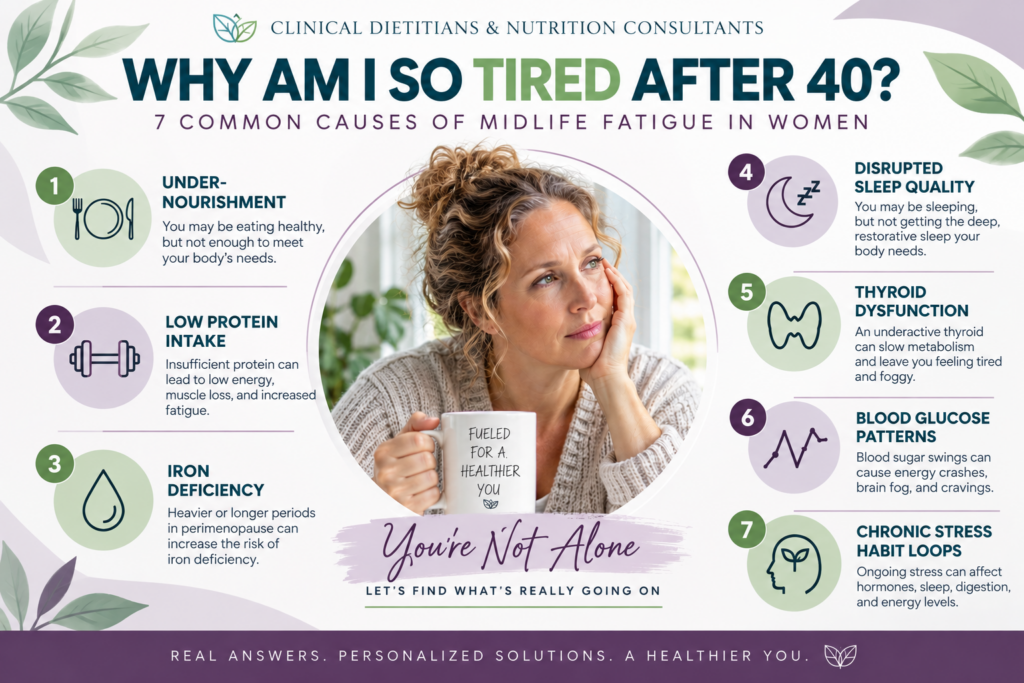
1. Under-Nourishment: Eating “Healthy” Is Not the Same as Eating Enough
Under-nourishment and under-eating are not the same thing. A dietary pattern can be genuinely nutritious and still fall short on total energy, protein, fiber, or specific micronutrients, particularly when several food categories have been eliminated. The body registers that shortfall as fatigue long before anyone would call the eating pattern unhealthy.
A diet can look exceptionally healthy and still fail to meet a woman’s individual needs.
I often see women begin the day with coffee, eat a very light breakfast, have a salad for lunch, and arrive home exhausted and extremely hungry.
Other women have eliminated carbohydrates, fats, dairy, gluten, or entire categories of food in pursuit of better health.
Sometimes restriction has become so normalized that a woman no longer realizes how little nourishment she is actually getting.
I look beyond whether foods are “healthy” and ask whether she is getting adequate:
- Energy
- Protein
- Fiber
- Healthy fats
- Nutrient-rich carbohydrates
- Vitamins and minerals
Sometimes improving energy isn’t about removing another food.
It is about nourishing the body more intelligently.
2. Low Protein Intake and Muscle Loss After 40
Muscle is metabolically active tissue, and women lose it at a rate of roughly 3 to 8 percent per decade after age 30. Less muscle means less capacity to store and use glucose, which is why low muscle mass shows up as fatigue and not only as weakness. Protein eaten mostly at dinner gives the body one window a day to repair that tissue instead of several.
After 40, protecting muscle becomes increasingly important.
Maintaining muscle supports strength, mobility, physical function, glucose metabolism, recovery, and healthy aging.
Yet many women eat relatively little protein early in the day and concentrate most of it at dinner.
A thoughtful nutrition assessment considers both total protein intake and how protein fits across the day, alongside resistance exercise, overall nourishment, and recovery.
I don’t want women simply eating less as they age.
I want them building a body that can remain strong, capable, and metabolically supported.
3. Iron Deficiency and Perimenopause: Heavy Periods Can Drain Your Energy
Heavier, longer, or more frequent periods during perimenopause can lead to iron deficiency, one of the most common and most missed causes of fatigue in women over 40. A 2025 study in Menopause found that women reporting three or more episodes of heavy menstrual bleeding during the previous six months had higher odds of reporting fatigue, including feeling tired, and the association held even after accounting for depression, anxiety, stress, sleep problems, and smoking.
Perimenopause does not always mean lighter periods.
Some women experience heavier, longer, or unpredictable bleeding during the menopausal transition. Significant blood loss can contribute to iron deficiency and, in some cases, iron-deficiency anemia.
Fatigue, weakness, reduced exercise tolerance, dizziness, or shortness of breath can have many causes, so symptoms should not be self-diagnosed.
But when a tired woman tells me her menstrual bleeding has changed significantly, I pay attention.
Her food matters.
Her menstrual history matters too.
And appropriate medical evaluation and laboratory testing may be warranted.
4. Thyroid Disease: Worth Evaluating, but Rarely the Whole Story
The thyroid is one of the most over-attributed causes of fatigue in midlife. It is also real, treatable, and genuinely missed in some women, which is why it belongs in the assessment rather than in the assumptions. Thyroid function is evaluated with blood testing ordered by your healthcare provider, starting with TSH. Symptoms can raise the question. They cannot answer it.
Fatigue and weight changes are frequently blamed on the thyroid.
Sometimes thyroid disease truly is part of the picture.
Sometimes it isn’t.
Fatigue alone cannot diagnose hypothyroidism, and symptoms such as weight changes, constipation, feeling cold, dry skin, and low energy can overlap with many other conditions.
This is where individualized assessment matters.
A functional approach should help us ask better questions, not give every woman the same diagnosis.
When symptoms and medical history suggest thyroid evaluation is appropriate, I encourage women to discuss it with their healthcare provider.
| Tired of guessing which one it is? A comprehensive nutrition assessment looks at all of these together rather than one at a time. Schedule a consultation in Greenville, SC. |
5. Poor Sleep Quality: You May Be Sleeping but Not Restoring
Sleep duration and sleep quality fail in different ways. You can spend eight hours in bed, be woken repeatedly by hot flashes, night sweats, pain, or undiagnosed sleep apnea, and still see a total on a sleep tracker that looks perfectly adequate. Fatigue alongside enough hours in bed is a quality question, not a quantity question, and sleep apnea deserves ruling out rather than assuming menopause explains it.
There is a difference between being in bed for eight hours and experiencing restorative sleep.
For women in midlife, hot flashes, night sweats, stress, pain, insomnia, and frequent waking can all interfere with sleep quality.
Sleep apnea should also not be overlooked.
Poor sleep can affect daytime energy, appetite, food choices, glucose metabolism, physical activity, and recovery.
So when a woman tells me:
“I sleep, but I never wake up refreshed,”
I don’t immediately reach for another supplement.
I want to understand how she is sleeping and why she may not be restoring.
6. Blood Sugar, Meal Timing, and the Afternoon Energy Crash
An afternoon energy crash is not always a blood sugar crash. An inadequate breakfast, a skipped or under-eaten lunch, low protein and fiber, poor sleep, high caffeine intake, and hours of sitting can all produce the same 3 p.m. exhaustion. Meal structure often makes a meaningful difference, but the pattern has to be identified before it can be corrected.
Women often describe feeling exhausted, hungry, shaky, or desperate for something sweet around 3 or 4 p.m.
Social media may label every afternoon slump a “blood sugar crash,” but the reality can be more complicated.
I look at the entire pattern:
- What did you eat for breakfast?
- Did you eat lunch?
- Was there adequate protein, fiber, and overall nourishment?
- How did you sleep?
- How much caffeine have you consumed?
- Have you been sitting for hours?
- Are there known concerns related to glucose regulation?
Sometimes meal structure can make a meaningful difference.
Other times, something else deserves attention.
Patterns give us information. Assumptions do not.
7. Chronic Stress and the Daily Habit Loop That Drains Energy
Fatigue in midlife is often maintained by a daily pattern rather than a single cause. Poor sleep leads to more caffeine and less food during the day, which leads to afternoon exhaustion, evening grazing, and a late bedtime, which leads back to poor sleep. Interrupting one point in that loop is usually more effective than trying to change everything at once.
Stress matters, but the story is more sophisticated than simply blaming every symptom on cortisol.
Consider this pattern:
| Poor sleep → Coffee → Skip breakfast → Work through lunch → Afternoon exhaustion → Sugar or more caffeine → Too tired to exercise → Evening grazing → Late bedtime → Poor sleep again |
That isn’t one isolated problem.
It is a loop.
This is where my work extends beyond traditional nutrition counseling.
Using evidence-informed behavior-change principles together with transformational and NLP-informed strategies, I help women recognize patterns that have become automatic and identify where they can realistically interrupt them.
Maybe the first change is breakfast.
Maybe it is eating an actual lunch.
Maybe it is a short afternoon walk.
Maybe it is changing the caffeine pattern.
Maybe it is creating a transition between work and home.
Or perhaps the sleep problem requires medical attention.
We don’t need to change everything at once. We need to identify the right place to begin.
When Fatigue Is Not a Nutrition Problem: Medical Causes to Rule Out
There is a line between fatigue that nutrition can address and fatigue that belongs to another clinician, and knowing where that line sits is part of responsible nutrition care. Food cannot correct a medical cause, and treating a medical cause as a food problem mostly delays the care that would have helped.
This is an important distinction.
Not every case of fatigue can, or should, be solved with food or supplements.
Certain medications can contribute to fatigue. So can sleep disorders, anemia, thyroid disease, diabetes, depression, infections and post-viral conditions, and a range of other medical issues.
Responsible functional nutrition means understanding where nutrition can help, and recognizing when another healthcare professional needs to be involved.
Food Is Fuel, and Also Part of a Nourished Life
I don’t want women becoming so focused on perfect nutrition that eating becomes another source of exhaustion.
Food provides energy and essential nutrients.
But food is also pleasure. Family. Culture. Memory. Connection.
Through my Food & Spirit approach, I encourage women to become more present with food rather than increasingly afraid of it.
- Can you recognize hunger before you become depleted?
- Can you sit down and actually experience a meal?
- Can you nourish yourself without believing that every food decision is another test you can pass or fail?
A healthy life should not require you to spend your entire day thinking about being healthy.
How a Functional Medicine Dietitian Evaluates Fatigue
A functional nutrition assessment for fatigue starts with history rather than supplements. It looks at when the fatigue began and what changed, how a woman is eating, sleeping, digesting, and moving, whether her menstrual cycle has changed, what medications and supplements she takes, and what her medical history and existing laboratory results already show.
When a woman comes to me exhausted, I don’t begin by asking: “Which supplement should we give you?”
I want to understand:
- When did the fatigue begin? What changed?
- How are you eating?
- How are you sleeping?
- How is your digestion?
- Has your menstrual cycle changed?
- What medications and supplements are you taking?
- How much are you moving?
- What does your medical history tell us?
- What laboratory information is already available, and what deserves further medical evaluation?
As a Registered Dietitian with more than 25 years of experience, my approach integrates functional medicine nutrition, women’s midlife health, metabolic and cardiovascular nutrition, digestive health, transformational behavior-change strategies, NLP-informed practices, and Food & Spirit principles.
I don’t look at fatigue in isolation.
I look at the woman experiencing it.
Because feeling better often begins not with doing more, but with understanding what your body actually needs.
Frequently Asked Questions About Fatigue After 40
Why am I so tired after 40 even when I sleep enough?
Time in bed and restorative sleep are not the same thing. In midlife, hot flashes, night sweats, pain, insomnia, and undiagnosed sleep apnea can fragment sleep quality without shortening sleep duration. Fatigue that persists despite adequate sleep also has nutritional and medical contributors, including inadequate protein and overall energy intake, iron deficiency, thyroid dysfunction, and blood glucose patterns.
Can perimenopause cause extreme fatigue?
It can contribute. Perimenopause does not always mean lighter periods. Heavier, longer, or unpredictable bleeding during the menopausal transition can lead to iron deficiency and, in some cases, iron deficiency anemia. Sleep disruption from hot flashes and night sweats is also common. Fatigue during perimenopause should be evaluated rather than assumed to be hormonal.
What deficiencies cause fatigue in women over 40?
Iron deficiency is one of the most common and is worth evaluating in any woman whose menstrual bleeding has increased. Inadequate total energy, protein, and overall nutrient intake also contribute, particularly in women who have eliminated entire food groups. Laboratory testing ordered through your healthcare provider is the appropriate way to identify a deficiency. Symptoms alone cannot confirm one.
Is my thyroid the reason I am tired all the time?
Sometimes, and sometimes not. Fatigue alone cannot diagnose hypothyroidism, and symptoms such as weight change, constipation, feeling cold, dry skin, and low energy overlap with many other conditions. If your symptoms and medical history suggest thyroid evaluation is appropriate, discuss testing with your healthcare provider.
When should I see a doctor about fatigue?
New, persistent, severe, or unexplained fatigue deserves medical evaluation. Fatigue accompanied by shortness of breath, dizziness, chest pain, significant changes in menstrual bleeding, or unintended weight change should be evaluated promptly. Medications, anemia, thyroid disease, diabetes, depression, sleep disorders, and post-viral conditions can all contribute.
Can a dietitian help with fatigue?
A comprehensive nutrition assessment can identify whether nutrition, meal structure, sleep patterns, digestion, or behavioral patterns are contributing to fatigue, and where they are not. A clinical dietitian can also recognize when a symptom belongs with another healthcare provider. At Clinical Dietitians & Nutrition Consultants in Greenville, South Carolina, that assessment looks at nutrition, health history, lifestyle, sleep, digestive and metabolic health, and individual needs.
Tired of Feeling Tired? Talk With a Dietitian in Greenville, SC
If you’re looking for a Functional Medicine Dietitian in Greenville, SC, and you’re tired of feeling tired despite trying to eat well and take care of yourself, it may be time for a more individualized approach.
During a comprehensive nutrition assessment, we can look more deeply at your nutrition, health history, lifestyle, sleep, digestive and metabolic health, behavioral patterns, and individual needs, and identify where your nutrition and lifestyle strategy may need to change.
You don’t need to guess your way through midlife.
You deserve to understand your body and have a strategy designed around you.
References
- National Institutes of Health, Office of Dietary Supplements. Iron: Fact Sheet for Consumers.
- The Menopause Society. Perimenopause. Patient Education.
- Abnormal uterine bleeding is associated with fatigue during the menopause transition. Menopause, Vol. 32, No. 6, June 2025.
- American Thyroid Association. Hypothyroidism.
- National Heart, Lung, and Blood Institute. Sleep Apnea.
| About the Author Vered Kantor, MS, RD, LDN, IC, CFCP Functional Medicine Dietitian | Transformation & NLP Practitioner | Food & Spirit PractitionerVered Kantor is a Registered Dietitian with more than 25 years of experience, practicing at Clinical Dietitians & Nutrition Consultants in Greenville, South Carolina. Her work focuses on women’s midlife health, metabolic and cardiovascular nutrition, and digestive health. |
This article is for educational purposes and is not a substitute for individualized medical advice, diagnosis, or treatment. Talk with your healthcare provider about symptoms that are new, persistent, severe, or unexplained.