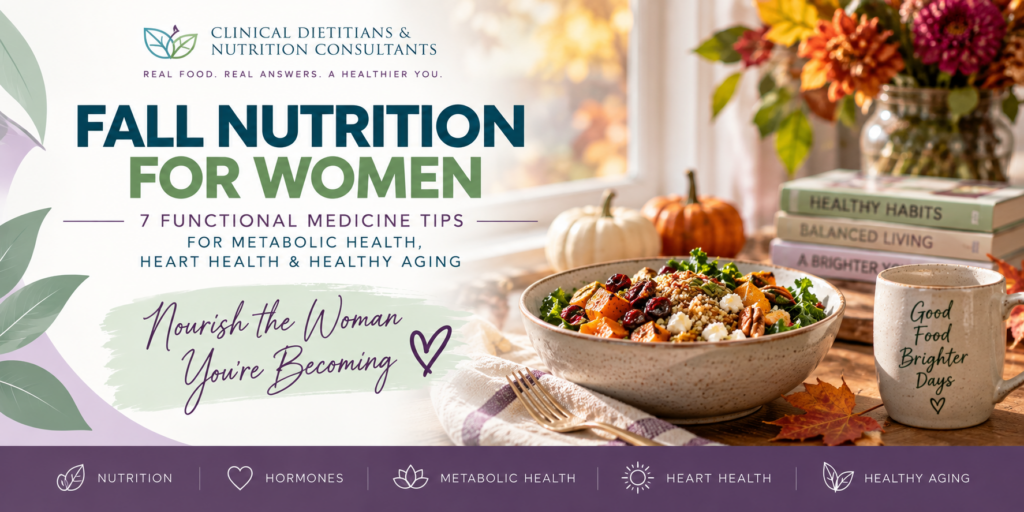
7 Functional Medicine Tips for Metabolic Health, Heart Health & Healthy Aging
| Key Takeaways A heart-healthy fall eating pattern is built on colorful, minimally processed foods, not on any single superfood. Plant diversity is one of the simplest ways to improve diet quality and support gut and metabolic health. Women lose muscle mass at roughly 3 to 8 percent per decade after age 30, which makes protein and resistance exercise more important, not less. How you eat affects digestion and satiety, not only what you eat. Persistent sleep disruption, night sweats, or fatigue during perimenopause deserve individualized attention rather than being dismissed as normal aging. |
Fall invites us to slow down, turn inward, and reconnect with what truly nourishes us.
Cooler mornings, earlier evenings, and changing leaves naturally shift the rhythm of our days. We begin reaching for warmer foods, comforting routines, and a little more time at home.
Yet for many women, fall also means busy schedules, less daylight, greater fatigue, and the familiar pattern of caring for everyone else while placing their own needs at the bottom of the list.
After more than 25 years of working with women, I have learned that meaningful health transformation rarely comes from simply knowing what to eat.
Lasting change happens when nutrition meets physiology, mindset, behavior, self-awareness, and self-care.
As a Functional Medicine Dietitian in Greenville, South Carolina, with more than 25 years of experience, my approach integrates functional medicine nutrition with transformational behavior-change strategies, NLP-informed practices, and Food & Spirit principles.
Instead of focusing only on “What should I eat?” I encourage women to explore a deeper question:
“What does my body, mind, and spirit need from me during this season of my life?”
This fall, rather than beginning another restrictive diet or wellness challenge, consider creating a more nourishing relationship with yourself.
1. Build a Fall Plate for Heart Health and Healthy Aging
A heart-healthy fall eating pattern is built on colorful, minimally processed foods rather than any single superfood. Leafy greens, Brussels sprouts, winter squash, pumpkin, beets, apples, and pears are all in season. Add protein from beans, lentils, fish, or poultry, and unsaturated fats in place of saturated fats. The overall pattern is what supports cholesterol, triglycerides, and cardiovascular risk.
From a functional nutrition perspective, food is much more than calories.
Every meal is an opportunity to provide your body with protein, fiber, healthy fats, vitamins, minerals, and an extraordinary variety of naturally occurring plant compounds.
For heart health, metabolic health, and healthy aging, build much of your eating pattern around colorful, minimally processed foods.
Fill your plate with leafy greens, broccoli, Brussels sprouts, cauliflower, mushrooms, beets, carrots, pumpkin, winter squash, berries, apples, pears, herbs, and spices.
Include protein from foods such as beans, lentils, chickpeas, tofu, tempeh, edamame, plain Greek or unsweetened plant-based yogurt, fish, and poultry according to your individual preferences and needs.
For women who eat fish, salmon, sardines, and trout are wonderful sources of protein and omega-3 fats.
Include heart-supportive fats from extra-virgin olive oil, walnuts, almonds, avocado, tahini, chia seeds, flaxseed, and pumpkin seeds.
A beautiful fall dinner might be a warm lentil and vegetable soup finished with extra-virgin olive oil, or a roasted vegetable bowl with Brussels sprouts, winter squash, quinoa, chickpeas, leafy greens, walnuts, and tahini.
Rather than searching for the latest “superfood,” focus on creating a nutrient-dense dietary pattern you can return to consistently.
| Your fall practice: Before your next meal, ask: “What can I add to this plate that will nourish my future self?” |
2. How the Language You Use About Food Reinforces the Pattern
The language women repeat about food tends to reinforce the pattern they are trying to change. Phrases like “I ruined my diet” or “I have no willpower” keep attention on what to stop rather than on what to build. Rehearsing the behavior you want, in specific detail, is more effective than rehearsing the one you are trying to avoid.
Many women approach nutrition through the language of correction:
- I need to lose weight.
- I shouldn’t have eaten that.
- I have no willpower.
- I ruined my diet.
- I’ll start again Monday.
But the language we repeatedly use around food can reinforce the very patterns we are trying to change.
This is where transformational and NLP-informed work can become useful.
Begin noticing your automatic thoughts and the language you use about yourself. Then practice rehearsing the behavior you want to strengthen instead of continually focusing on what you want to stop doing.
Imagine yourself preparing a nourishing breakfast.
Picture yourself taking time for lunch instead of working through it.
Visualize arriving home after a stressful day, pausing before automatically reaching for food, taking a few slow breaths, and asking yourself what you actually need.
This isn’t about trying to “think yourself thin.” It is about bringing awareness to habitual cues and practicing a different response. I have written more about the behavior patterns that keep weight stuck if this is familiar territory for you.
| Your fall practice: Complete this sentence each morning: “The woman I am becoming takes care of herself by __________.”Then choose one small action that makes that statement real today. |
3. Plant Diversity: Eat the Colors of Fall for Gut and Metabolic Health
Increasing the variety of plant foods you eat is one of the simplest ways to improve diet quality and support gut and metabolic health. Fall makes it easy: deep greens, orange and gold squash and root vegetables, red and purple beets and cranberries, and white and earthy mushrooms, onions, beans, and lentils. Fresh, frozen, and no-salt-added canned foods all count.
One of the simplest ways to improve the nutritional quality of your diet is to increase the variety of plant foods you eat.
Fall gives us an extraordinary palette.
- Deep green: kale, spinach, arugula, broccoli, Brussels sprouts
- Orange and gold: pumpkin, carrots, sweet potatoes, winter squash
- Red and purple: beets, red cabbage, berries, cranberries, pomegranate
- White and earthy: cauliflower, onions, garlic, mushrooms, beans, lentils
- And also: apples, pears, walnuts, herbs, seeds, whole grains
Instead of always asking “How little can I eat?” try asking “How much nourishment and plant diversity can I bring to my week?”
That small shift moves us away from deprivation and toward nourishment.
Fresh, frozen, and no-salt-added canned foods can all have a place in a healthy kitchen. Good nutrition does not have to be complicated to be valuable.
| Your fall practice: Choose one seasonal plant food each week and prepare it in two different ways. |

4. Physical Hunger vs. Emotional Hunger: Listening for the Need Beneath It
Physical hunger and emotional hunger can feel similar in the moment. The difference usually shows up in what preceded the urge and in what would actually satisfy it. Pausing to ask when you last ate a satisfying meal, what happened just before the urge, and what you are feeling gives you information. Sometimes the answer is food. Sometimes hunger arrives alongside exhaustion, stress, or the need for a moment of peace.
Food is not simply fuel.
It is pleasure. Tradition. Culture. Memory. Celebration. Connection. And sometimes, comfort.
There is nothing inherently wrong with finding comfort in food. But greater awareness gives us more choices.
Before automatically reaching for something to eat, pause gently and ask:
- What am I noticing in my body?
- When did I last eat a satisfying meal?
- Am I physically hungry?
- What happened immediately before I wanted to eat?
- What am I feeling right now?
- What do I truly need?
Sometimes the answer is food.
If you are hungry, nourish yourself.
But sometimes hunger exists alongside exhaustion, stress, loneliness, boredom, frustration, or the simple need for a moment of peace.
You may need nourishment and rest. Food and connection. A snack and reassurance.
This is where nutrition, behavior, and self-awareness begin to intersect.
| Your fall practice: Create two personal menus. Your Nourishment Menu contains foods and meals that leave you feeling satisfied, energized, and cared for. Your Self-Care Menu contains experiences that restore you: perhaps a warm shower, music, journaling, calling a friend, sitting outdoors, reading, breathing, stretching, or simply allowing yourself to be still. Both belong in a healthy life. |
5. How You Eat Matters: Rituals, Digestion, and the Nervous System
How you eat affects digestion, satiety, and satisfaction, not only what you eat. Eating while working keeps the nervous system in task mode, while sitting down, slowing the first few bites, and noticing your food supports the state in which digestion happens more comfortably. Ritual does not have to be elaborate to matter.
Through my Food & Spirit work, I encourage women to remember that nourishment extends beyond the nutritional composition of a meal.
How we experience food matters too.
A beautiful bowl of vegetable soup eaten hurriedly while answering emails is a different experience from sitting at a table, noticing its warmth and aroma, slowing down, and allowing yourself to receive the meal.
Ritual does not have to be elaborate.
Sometimes ritual simply means being present for your own life.
- Set the table.
- Use the beautiful bowl instead of saving it for company.
- Light a candle.
- Pause for gratitude.
- Notice the colors on your plate.
- Take your first few bites slowly.
- Allow yourself to taste your food.
Your nervous system does not need another task to complete. Sometimes it needs an opportunity to experience safety, pleasure, connection, and presence.
| Your fall practice: Choose one meal each day to turn into a small nourishment ritual. No computer. No phone. No judgment. Just food, awareness, and presence. |
| Want this built around your health history rather than a template?Schedule a consultation in Greenville, SC. |
6. Movement for Muscle, Insulin Sensitivity, and Independence
Movement in midlife is better framed as an investment than as compensation. Women lose muscle mass at a rate of roughly 3 to 8 percent per decade after age 30, and muscle supports strength, mobility, balance, insulin sensitivity, and independence. Resistance training, walking, and mobility work protect those things in a way that burning calories does not.
For many women, exercise has been intertwined with weight and compensation for years.
- I ate too much, so I need to exercise.
- I need to burn this off.
- I didn’t work out today, so I failed.
There is another way to think about movement.
Especially during midlife and beyond, movement can become an investment in your future. Strength. Muscle. Mobility. Balance. Cardiovascular fitness. Metabolic health. Confidence. Independence.
Walk outdoors in the beautiful fall weather. Strength train. Practice yoga or Pilates. Stretch. Dance. Work on mobility and balance.
And instead of asking only “How many calories did I burn?” ask “What am I helping my body become capable of?”
Imagine yourself ten or twenty years from today.
How do you want to move? What activities do you want to continue enjoying? How strong and independent do you want to feel?
| Your fall practice: Choose movement today that supports the woman you want to be tomorrow. And on demanding days, remember that the shorter version still counts. |
7. Sleep, Rest, and Recovery in Perimenopause and Menopause
Rest, sleep, and recovery are part of healthy aging, not separate from it. Up to 80 percent of women experience hot flashes and night sweats at some point during the menopause transition, and sleep disruption commonly accompanies them. Persistent sleep problems, night sweats, or ongoing fatigue during perimenopause deserve individualized attention rather than being dismissed as a normal part of aging.
Healthy aging is not created through nutrition and exercise alone.
Rest matters. Sleep matters. Recovery matters. Relationships matter. Meaning matters.
And sometimes wellness involves recognizing what we no longer need to carry.
Fall itself gives us a beautiful metaphor. Trees release what they no longer need.
Perhaps we can ask ourselves: “What am I ready to release this season?”
- Perfectionism?
- All-or-nothing thinking?
- Guilt around food?
- Constant productivity?
- An old habit?
- A belief about your body that no longer serves you?
- Or perhaps the expectation that caring for yourself should always come after caring for everyone else?
Create a gentle transition into your evening. Write tomorrow’s tasks on paper rather than carrying them mentally into bed. Dim the lights. Stretch. Read. Journal. Breathe. Sit quietly.
During perimenopause and menopause, persistent sleep disruption, night sweats, or ongoing fatigue deserve individualized attention rather than simply being dismissed as an unavoidable part of getting older. Conditions such as obstructive sleep apnea may warrant medical evaluation, and I have written separately about why women lose energy in midlife.
| Your fall practice: Before bed, ask yourself three questions.What can I release from today?What did I do today that supported my well-being?What does my body need from me tomorrow? |
Fall Is an Invitation to Come Back to Yourself
Women are often given another diet when what they really need is a more complete approach to health.
Nutrition matters enormously.
But so do your thoughts. Your habits. Your environment. Your relationship with food. Your relationship with your body. Your ability to recognize your needs. Your capacity to rest. And the meaning, pleasure, and connection you bring into your everyday life.
This is why I believe meaningful nutrition work should extend beyond simply handing someone a meal plan.
We nourish the whole woman: body, mind, heart, and spirit.
Transformation happens through small practices repeated consistently enough that they gradually become part of how we live.
So this fall, instead of asking “What diet should I start?” ask “How do I want to nourish the woman I am becoming?”
Then begin with one choice. One nourishing meal. One walk. One boundary. One moment of awareness. One evening of rest. One small promise to yourself that you can realistically keep.
Because meaningful transformation is rarely created in one dramatic moment. It is built in the ordinary moments when you repeatedly choose to care for yourself.
Frequently Asked Questions About Fall Nutrition
What are the best fall foods for heart health?
Leafy greens, broccoli, Brussels sprouts, cauliflower, mushrooms, beets, carrots, pumpkin, and winter squash are all in season and all support a heart-healthy eating pattern. Add protein from beans, lentils, chickpeas, fish, or poultry, and unsaturated fats from extra virgin olive oil, walnuts, almonds, avocado, and seeds. The overall dietary pattern matters far more for cholesterol and triglycerides than any single food.
What should women over 40 eat in the fall?
Build most meals around colorful, minimally processed foods, with adequate protein spread across the day and plenty of fiber-rich plants. After 40, protein and resistance exercise become more important for protecting muscle, and plant diversity supports gut and metabolic health. Individual needs vary with health history, activity, medications, and menopausal status.
How do I tell physical hunger from emotional hunger?
Pause before eating and ask when you last ate a satisfying meal, what happened immediately before the urge appeared, what you are feeling, and what you actually need. Physical hunger builds gradually and is satisfied by food. Emotional hunger often arrives suddenly, follows a specific trigger, and is really a request for rest, connection, or relief. Sometimes both are present at once.
Does eating slowly actually help digestion?
How you eat affects digestion, satiety, and satisfaction, not only what you eat. Eating while working keeps the nervous system in task mode, while sitting down, slowing the first few bites, and noticing your food supports the state in which digestion happens more comfortably. It also gives fullness signals time to register.
Why is sleep disrupted during perimenopause and menopause?
Up to 80 percent of women experience hot flashes and night sweats at some point during the menopause transition, and sleep disruption frequently accompanies them. Stress, pain, and insomnia also contribute. Persistent sleep problems should not be assumed to be hormonal, because conditions such as obstructive sleep apnea may warrant medical evaluation.
Can a dietitian help me build a seasonal eating pattern?
A comprehensive nutrition assessment looks at health history, nutritional needs, preferences, goals, and season of life, and builds an eating pattern you can actually sustain rather than a template. At Clinical Dietitians & Nutrition Consultants in Greenville, South Carolina, that includes metabolic and cardiovascular health, digestive health, and the behavioral patterns that shape everyday eating.
Ready for a More Personalized Approach? Talk With a Dietitian in Greenville, SC
If you are navigating metabolic changes, weight resistance, digestive concerns, cardiovascular risk, perimenopause, menopause, or simply want to create a healthier relationship with food and your body, individualized guidance can help.
As a Functional Medicine Dietitian in Greenville, South Carolina, I work with women who are looking for a deeper, more personalized approach to nutrition and well-being.
My approach integrates functional medicine nutrition, transformational behavior-change strategies, NLP-informed practices, and Food & Spirit principles to look beyond simply what you eat and explore the physiology, habits, patterns, mindset, and everyday experiences that influence your well-being.
Together, during a comprehensive nutrition assessment, we can develop a thoughtful nutrition and lifestyle approach based on your health history, nutritional needs, preferences, goals, and season of life.
You don’t need another generic nutrition plan. You deserve an approach designed around you.
| About the Author Vered Kantor, MS, RD, LDN, IC, CFCP Functional Medicine Dietitian | Transformation & NLP Practitioner | Food & Spirit Practitioner Vered Kantor is a Registered Dietitian with more than 25 years of experience, practicing at Clinical Dietitians & Nutrition Consultants in Greenville, South Carolina. Her work focuses on women’s midlife health, metabolic and cardiovascular nutrition, and digestive health. |
This article is for educational purposes and is not a substitute for individualized medical advice, diagnosis, or treatment. Talk with your healthcare provider about symptoms that are new, persistent, severe, or unexplained.